

KP-6 Sea Cooler
The KP‑6 sea cooler delivers up to 500 liters per hour of seawater chilled down to ‑1 °C. A minimum salinity of 2.6 % NaCl is required; if higher salinity is needed, a brine system can be utilized. At a seawater temperature of 15 °C, water usage can reach up to 1,000 liters per hour, with a 100‑micron filtration requirement.
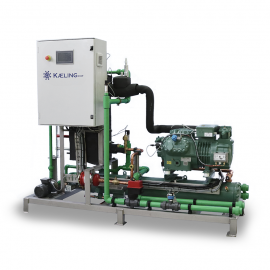
The KP‑6 seawater cooler is compact yet powerful
Delivering up to 500 liters per hour.
Sea coolers from Kæling Víkurafl are the result of decades of development and real‑world use under demanding conditions in Icelandic waters and around the world. Our seawater coolers are built to the highest quality standards and designed for those who want to leverage modern cooling technology to maximize catch value.
KP‑6 seawater cooler at a glance
When used for equipment cooling with seawater at 15°C, water consumption is up to 1,000 liters per hour, with a filtration requirement of 100 microns.
| Power supply: | 3x 230 V / 3x 400V |
| Power consumption: | 5 kW |
| Cooling capacity: | 6 kW |
| Cooling performance kcal/h: | 5,000 kW |
| Cooling rate from 10°C í 0°C: | 500 L/h. |
| Minimum salinity requirement: | 2.6% NaCl |
| Dimensions (LxBxH): | 1200x500x725mm |
| Weight: | 180 kg |
| Refrigerant: | R404A / R449A |
| Seawater filtration: | 100 µm |
| Seawater usage for equipment cooling at 15°C: | 1,500 L/h. |
Durability and reliability
A service life of up to 25 years can be expected
In the design and production of seawater coolers from Kæling Víkurafl, only the best possible components and materials available at any given time are used. One of the distinguishing features of our seawater coolers is the use of titanium plate heat exchangers, which significantly increase both performance and durability.
With regular maintenance and system upgrades, a service life of up to 25 years — or even longer — can be expected.
Fyrir fiskiskip og vinnslur í landi
Algengt er að nota sjókæla um borð í fiskiskipum en einnig í ákveðnum tilfellum fyrir vinnslur í landi.
Sjókælar eru fáanlegir í all mörgum stöðluðum útfærslum en einnig sérhannaðir fyrir allar stærðir fiskiskipa og fiskvinnslur í landi.
Chilled seawater is highly effective for maintaining the correct temperature at every stage
Chilled seawater is extremely effective for maintaining the proper temperature of the catch throughout all stages of processing — from the moment it comes on board until storage cooling begins.
The surface temperature of seawater is often higher than the temperature of the catch
The surface temperature of seawater is often higher than the deeper water the catch comes from. Pumping seawater directly from the surface can therefore accelerate the loss of freshness.
When selecting a seawater cooler, it is important to consider that seawater temperature can vary significantly between seasons, which directly affects the system’s performance capacity.
Seawater coolers can chill water down to as low as -1°C
Seawater coolers can be used to pre-chill the catch to -1°C before it is transferred to the hold following gutting and washing. After pre-chilling, the hold is typically maintained at 0°C.
By cooling the catch immediately in tubs using chilled seawater, the amount of ice required for the fish is also significantly reduced.
Seawater temperature affects performance
The colder the seawater, the higher the performance of seawater coolers equipped with “Max Flow” functionality. This system works by using software that actively maintains a stable outlet temperature from the cooler, regardless of the incoming water flow.
As a result, there is a significant difference in flow capacity depending on whether the seawater temperature is 5°C or 20°C. This seawater cooler is available with the Max Flow configuration.
Option for multiple chilled seawater outlets with different temperatures
Seawater coolers can be configured to provide outlets with differently chilled seawater for each processing stage. This enables precise cooling throughout the workflow, maximizing the quality of the catch. Proper cooling slows the growth of bacteria and reduces enzymatic activity.
Advanced modern control systems with remote access
Since seawater temperature can vary significantly between seasons, it is important to automatically control both flow and temperature in response to changing conditions. This is handled by a modern control system that ensures precise cooling regardless of seawater temperature.
The control panel can be installed in almost any location, and multiple displays can be added if needed.
Remote service available
The control systems from Kæling Víkurafl for seawater coolers offer remote connectivity, allowing our service team to access the coolers wherever they are located — as long as there is an internet connection. Remote access is used to monitor the status of the cooler, perform maintenance, and fine-tune the system when needed.
Option for electrically or hydraulically driven seawater coolers
Conventional seawater coolers are connected to the vessel’s electrical system, but Kæling Víkurafl also offers hydraulically driven models for vessels that are not equipped with a generator. Hydraulic technology is particularly useful in situations where access to 220V or 400V power is limited. The compressor on the cooler is powered by the ship’s hydraulic system, the seawater pump requires 24V electricity, and the control panels require 220V.
Seawater coolers and slurry ice machines work well together
Seawater coolers are often used alongside slurry ice machines to improve energy efficiency and overall performance.
Typically, the seawater is chilled to 0°C before it is pumped into the slurry ice machine. This allows for greater ice production, faster processing, and significantly lower energy consumption compared to using unchilled seawater directly.
Sales and service of seawater coolers worldwide
Kæling Víkurafl offers seawater coolers and other cooling equipment to customers around the world. While we have a strong position in the Icelandic market, our main export countries include the United States, Canada, Norway, the United Kingdom, the Faroe Islands, and others.
We provide all our international customers with professional service — whether at their facilities, on board their vessels, or via remote support.
Our cooling specialists assist with system selection
There are many factors to consider when selecting a seawater cooler, and it is essential to conduct a focused needs analysis. This includes, for example, the volume of catch that needs to be cooled over a given period and the seawater temperatures during the fishing season. Different fishing grounds and seasonal variations can have a significant impact on these requirements.
Get in touch
Don’t hesitate to get in touch with us. We take pride in providing outstanding service and only offer high-quality products we trust — products that we know contribute to increased catch value.
We offer a wide range of seawater coolers suitable for fishing vessels of all sizes.



The company
Kæling Víkurafl ehf.
Stapahraun 6
220 Hafnarfjörður
Iceland
Icelandic Identification Number: 410605-0900
VAT nr.: 103750
Contact us
- +354-565-7918
- +354-891-7918
- info@cooling.is